Water Line Repair in Lakewood, CA
The line from the street to your house is your water supply's lifeline, and when it breaks, everything downstream goes. We locate the break, dig precisely, and repair the line.
Signs your main water line is broken
A main-line break announces itself differently than an indoor leak. The clues are outside as often as inside.
Every fixture loses pressure at once
A break inside the house usually hits one room or one line. When the whole house goes weak together, every faucet, every shower, the problem is upstream, on the main feeding them all.
Soggy ground or pooling water
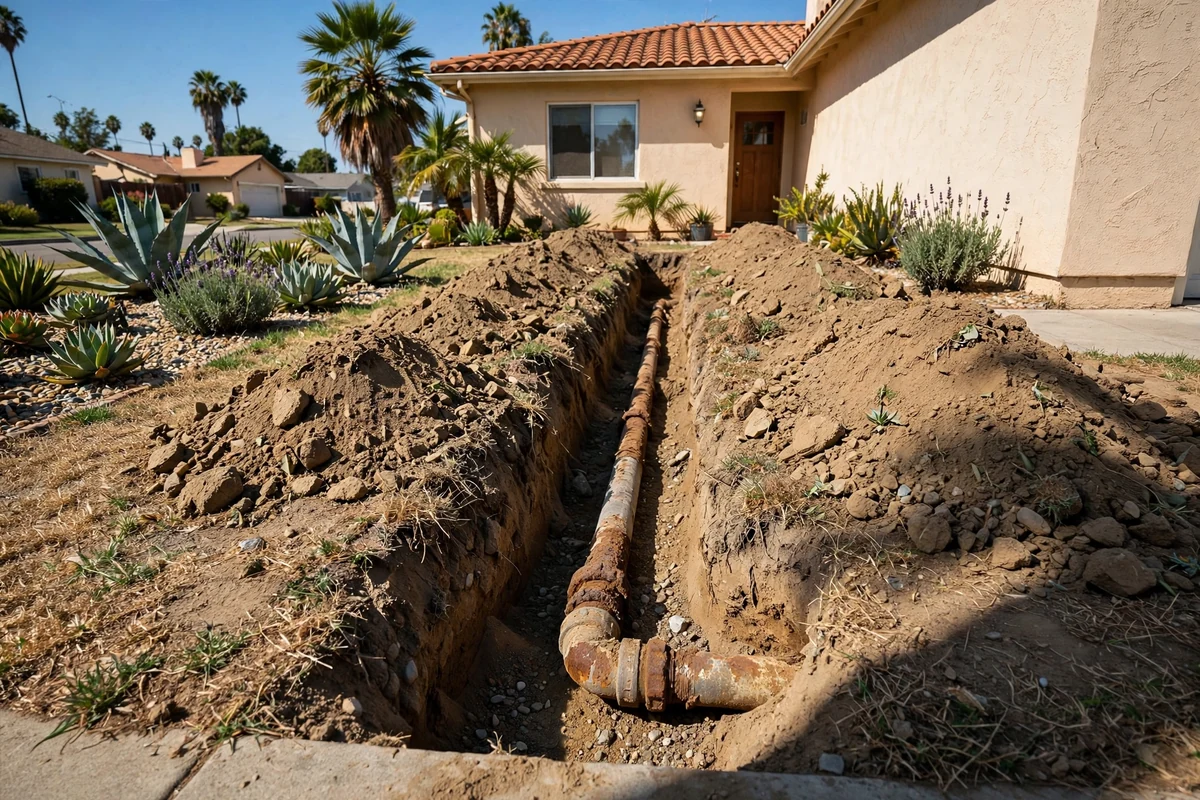
A persistently wet patch in the yard, water pooling where it never did before, or soil that stays soft between the street and your house. The break pushes water up through the soil, and gravity does the rest.
One patch of grass grows suspiciously well
An underground leak is an irrigation system you didn't install. A strip of lawn that's greener, taller, and lusher than everything around it often traces the leaking line's path.
The meter spins with everything off
Turn off every fixture in the house and watch the water meter. If the dial keeps moving, water is leaving your system, and if nothing inside is running, the leak is in the line between the meter and the house.
Discolored water from every tap
Brownish or rusty water at all fixtures together points to a failing service line, especially an aging galvanized one shedding corrosion into the flow. One tap alone means a local problem; all of them means the main.
A hissing sound near the main shutoff
With the house quiet, listen near where the line enters the home or at the meter box. A steady hiss with no water running is pressurized water escaping underground, the audible signature of a line break.
Seeing water where it shouldn't be? Call and describe what you're seeing — we’ll tell you the safest next step.
Call (562) 245-5416What breaks a main water line
Main lines live underground for decades. Here's what finally gets them.
Age and corrosion. Many service lines in the area are original copper or galvanized steel, decades into their working life. Galvanized lines corrode from the inside until flow chokes and walls give way; copper thins and pits the same way it does indoors, it just does it out of sight.
High water pressure. Municipal pressure that runs hot stresses every joint, bend, and thin spot along the line, thousands of times a day. A line that would have lasted years longer at normal pressure fails early under constant hammering. If your pressure is high, our water pressure regulator installation service protects the new line too.
Ground movement. Soil shifts with moisture changes, settling, and nearby construction. A rigid line that can't flex with the ground eventually cracks at a joint or a stressed section, the break often shows up months after the shift that caused it.
Tree roots. Roots seek moisture and press against buried lines, working into joints and hairline cracks. An old line with a weeping joint is practically an invitation. If your break sits near a mature tree, roots are a prime suspect.
How we repair a water line
Locate first, dig second, restore last. That order keeps your yard, and your water bill, intact.
Confirm and locate
Meter tests and indoor checks confirm the break is on the main. Then acoustic equipment and ground probes trace the line and mark the break's exact position.
Dig at the mark
A targeted trench goes in at the confirmed location, sized to the repair, not to guesswork. Utilities are marked and avoided before any shovel work.
Repair the section
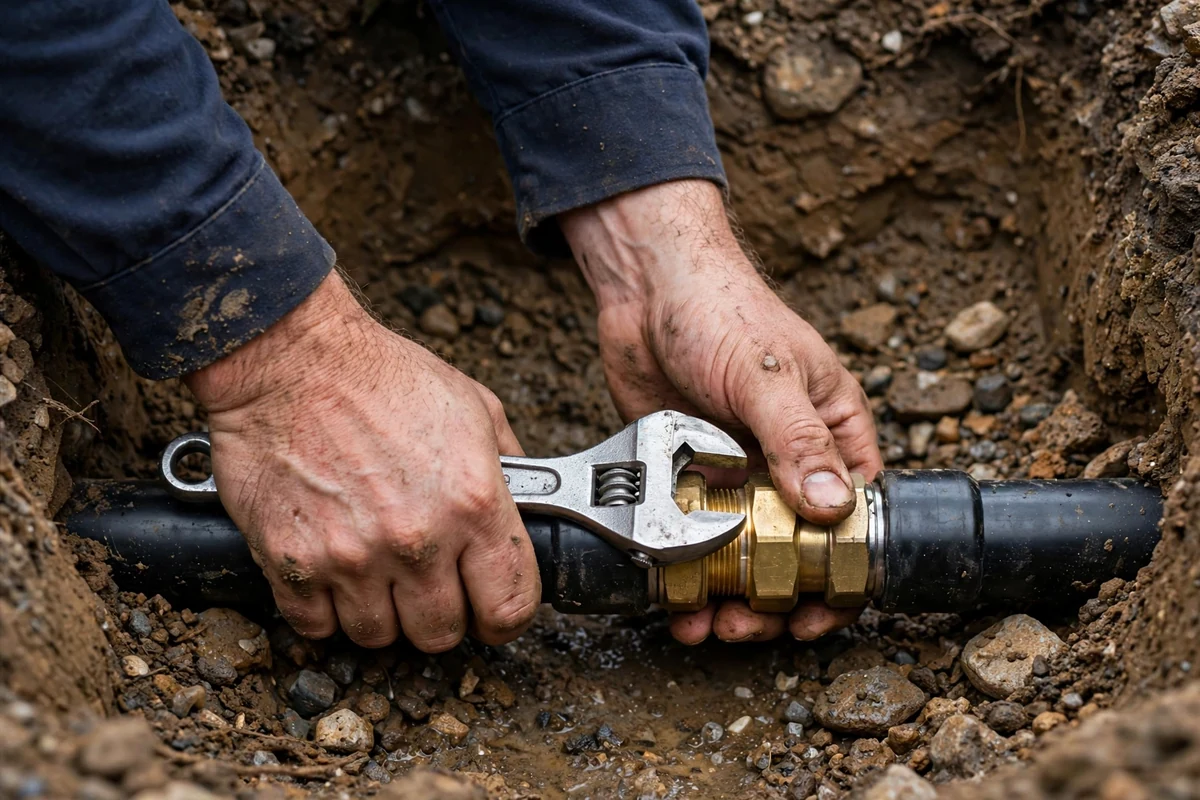
The failed length is cut out and replaced with sound pipe and proper couplings, matched to the line. The connection is pressure-tested before anything is buried.
Backfill and restore
The trench is backfilled in compacted layers to prevent settling, and the surface is restored. Your water comes back on as soon as the repair passes testing.
When a repair is enough, and when it isn't
The honest question every main-line job raises, answered with evidence, not a sales pitch.
Repair wins when the break is isolated and the rest of the line is sound: a single cracked joint, one root-damaged section, a localized failure in an otherwise healthy pipe. We cut out the bad length, couple in new pipe, and you're done, one trench, one fix.
Replacement wins when the exposed pipe tells a bigger story: heavy interior corrosion, thinning walls along the run, or a line that has already broken once before. A second trench six months from now costs more than doing the whole line once, and we'd rather tell you that now.
Either way, you see the pipe's condition with your own eyes before deciding. And if replacement is the call, our water line replacement work handles the full run, while burst pipe leak detection is what found the break in the first place. Homeowners in Lakewood and across our service areas get the same straight answer.
A small leak never stays small. Call before a pinhole becomes a flood.
Call (562) 245-5416Whose line is it, anyway?
Here's the rule of thumb: you own the service line from the water meter to your house; the water utility owns from the meter back to the street main. We'll help you confirm where the break sits relative to the meter, because that decides who covers the repair, and it's worth knowing before anyone digs.
Water line questions
What homeowners ask before the trench opens.
How do I know the break is in my main water line and not inside the house?
The pattern gives it away: every fixture in the house loses pressure at once, you hear water running with nothing on, the meter spins with all indoor fixtures closed, or you see soggy ground, pooling water, or an unusually green patch in the yard between the street and the house. A break inside the house usually affects one area; a main-line break affects everything.
Do you dig up my whole yard to fix a water line?
No. We locate the break first with acoustic equipment and ground probes, then dig only at the confirmed spot. The trench is kept as small as the repair allows, and we backfill and restore the area when the pipe is fixed.
What causes a main water line to break?
The common causes are age and corrosion thinning the pipe, high water pressure stressing joints and weak points, ground movement shifting the soil around the line, and old galvanized or copper service lines simply reaching the end of their life. Tree roots can also press against and crack older lines.
Should I repair the break or replace the whole line?
A single break in an otherwise sound line is a repair job. But when the line is old, corroded along its length, or has broken before, a full replacement saves you from the next dig. We show you the pipe's condition at the break so the choice is based on evidence.
How long will I be without water?
Water is off only during the actual repair work, not for the whole visit. We schedule the shutoff around the digging and connection steps so the interruption is as short as the job allows, and we tell you the plan before we start.
Who is responsible for the water line, me or the water company?
Generally, the homeowner owns the service line from the water meter to the house, and the water utility owns everything from the meter back to the street main. We can help you confirm where the break sits relative to the meter, that decides whose responsibility the repair is.
Your main line can't wait. A broken service line wastes water by the hour and leaves your home dry. Let us find the break and fix it right.
Call (562) 245-5416Contact Lakewood Pipe Rescue
Reach out any time, a real person answers and gets help moving.
Call
(562) 245-5416
Emergency line, call any time.
Visit
4400 Ladoga Ave
Lakewood, CA 90713, USA
[email protected]
We reply within one business day.
Prefer to talk it through?
Call and describe what's happening, pressure gone everywhere, wet spots in the yard, a meter that won't stop. We'll tell you the safest next step before anyone rolls a truck.
Sources & Further Reading
Official references behind the facts on this page.
- U.S. EPA, Fix a Leak Week, household leak facts and the meter check.
- USGS Water Science School, how water moves through service lines and soil.
Links open official sources in a new tab. We re-check them yearly.